The Neuroscience of Handwriting
- Handwritten Exchange
- Dec 12, 2025
- 5 min read
Why Ink Connects Deeper Than Pixels

There is a specific reaction that happens when you spot a handwritten envelope in your mailbox. It stands out against the bills and junk flyers. Your pulse slows down a little. Your focus narrows. For a minute, the noise of the day fades into the background. You forget about the relentless pings and the emails demanding immediate attention.
We usually chalk this up to nostalgia. We tell ourselves we just miss the "good old days."
But science tells a different story. The relief you feel isn't just sentimental. It’s neurological.
Our world is optimized for speed. We’ve abandoned the pen for the keyboard. We type faster than we write, and we auto-complete sentences before we’ve even finished thinking them. But in this rush for efficiency, we sacrificed something vital. We lost the way our brains process emotion, memory, and connection.
At Handwritten Exchange, we believe that writing letters isn’t a retreat into the past. It is a necessary tool for cognitive health in the future. Here is what the neuroscience says about why your brain craves the slow friction of pen on paper.
The Myth of "Frictionless" Communication
Tech companies spent the last twenty years removing "friction" from our lives. We can send a message halfway across the world in milliseconds. We can tap a suggestion to reply to an email without typing a single word.
From a neurological perspective, however, friction isn't the enemy. It is actually where the magic happens.
When you type, you perform a rote motor function. Typing "A" or "Z" is basically the same motion. It is just a tap. It is so automatic that most of us do it without looking. We become data processors instead of thinkers.
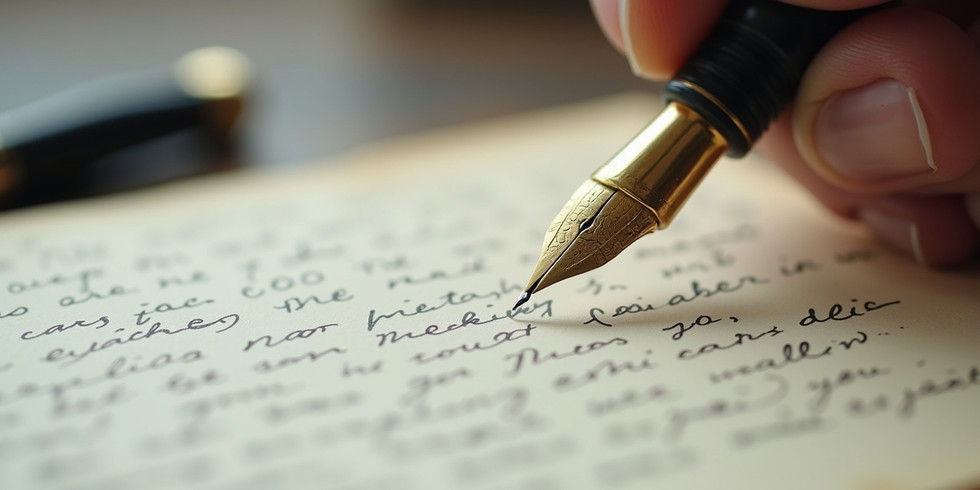
Handwriting is different. It is a complex motor skill. You have to plan the shape of the character, manage the pressure of the pen, and coordinate your hands with your eyes. This fires up the Reticular Activating System (RAS) in your brain stem. The RAS acts as a filter for the millions of data points hitting you every second. It decides what gets attention and what gets ignored.
When you physically write, that complex input signals to your RAS that this activity needs focus. You aren't just recording words. You are signaling to your brain that this matters.
The "Connectivity" Effect: What EEGs Reveal
Psychologists have observed for years that people seem to understand concepts better when they write them down. Now, hard neuroscience explains why.
A 2024 study from the Norwegian University of Science and Technology (NTNU) used high-density EEGs to track brain activity in students while they wrote by hand versus typing.
The results were stark. When writing by hand, the brain showed significantly increased connectivity between the parietal and central regions. These are the areas crucial for memory and learning. The brain was literally lighting up with new pathways. When typing, those connections remained dormant.
This supports the theory of "generative encoding." Because handwriting is slow, you cannot transcribe your thoughts verbatim like you do on a keyboard. You are forced to digest and summarize the emotion before you commit it to paper. You aren't just dumping a stream of consciousness. You are actively processing your own life.
When you write a letter to a stranger on Handwritten Exchange, you engage in this deep cognitive work. You cement the memory of that moment in your own mind far more effectively than a digital journal entry ever could.


The Empathy Gap: Reading Bio-Metrics, Not Fonts
These benefits aren't limited to the writer. They are perhaps even more profound for the receiver.
When you get a text message, your brain processes the font as a standardized symbol. A text from your mother looks exactly the same as a text from a spam bot. The screen strips away the humanity of the sender and leaves only raw data.
Handwriting is biometrics in ink.
Behavioral scientists note that handwriting carries "prosody," which is the visual equivalent of rhythm and tone in speech. When you read a letter, you can see where the writer hesitated. You see where they pressed harder because they were angry or passionate. You notice the slant change as they grew tired.
This triggers mirror neurons. These are cells in the brain that fire not only when we do something, but when we watch someone else do it. When you trace the loop of a stranger’s "y" or the cross of their "t," your brain simulates the action of writing that letter itself.
This creates a bridge of "embodied empathy." You aren't just reading data. You are physically resonating with the effort the other person took to create it. In an age of digital isolation, this physical proof of another human's presence is the antidote to loneliness. It proves that someone stopped their world to focus entirely on you.


Emotional Regulation: The Power of No Backspace
Maybe the most therapeutic part of an analog letter is that there is no "delete" key.
On a screen, we edit as we go. We type a sentence, decide it sounds too vulnerable, delete it, and replace it with something safer. We curate our persona in real-time. This leads to the performance of social media where we present the polished version of our lives.
Paper demands commitment. Once the ink touches the page, it stays there. If you make a mistake, you have to cross it out or accept it. If you start a sentence, you have to find a way to finish it.
This linearity forces a process known as acceptance. You cannot erase the past, so you must move forward. This slows down your emotional reactivity.
In therapy, this is often called "cooling off." The time it takes to write a sentence is longer than the time it takes to feel the emotion. This delay allows your prefrontal cortex to catch up with your amygdala. That means your reasoning catches up with your feelings.
The result is that letters are rarely knee-jerk reactions. They are more nuanced, thoughtful, and honest than digital communication. When you write to a partner through Handwritten Exchange, you practice the art of sitting with your thoughts until they are fully formed.
Reclaiming Your Cognitive Sanctuary
We live in an "Attention Economy." Massive companies engineer algorithms designed to fracture your focus and keep you scrolling. They hack your dopamine loops to ensure you never feel fully satisfied.
Writing a letter is an act of rebellion against this economy.
It requires "deep work." It forces you to create a sanctuary. You need a physical space and a quiet environment where the digital world cannot intrude. By engaging in this ritual, you retrain your brain. You lengthen your attention span. You teach your mind that it is okay to focus on one single thing for twenty minutes without checking a notification.
This is why Handwritten Exchange exists. We aren't selling stationery. We are offering a framework for cognitive resistance.
When you sit down to write your first letter, you might feel the itch of distraction. You might feel your hand cramp. You might wonder if you are doing it right. But as you continue, pay attention to what happens in your head. Feel the quiet. Feel the weight of the pen. Feel the satisfaction of folding the paper and sealing the envelope.
That feeling is your humanity coming back online.


Ready to reconnect?
The science is clear. We need this. If you are tired of surface-level digital noise and are ready to engage your brain and your heart in a deeper way, we have a spot for you.


Comments